Hem Blogg Sida 2

Beginner-Friendly Work From Home Jobs (Why Live Chat Is One of the Easiest to Start With)

When people look for work from home jobs, one concern comes up again and again:

“I don’t have experience.”

And that concern stops many people before they even start.

The truth is, not all remote jobs require advanced skills, long resumes, or years of experience. Some are designed to be entry-level by default.

Live chat jobs fall into that category.

What Makes a Job Beginner-Friendly?

A beginner-friendly remote job usually has a few things in common:

  • Clear instructions
  • Repeatable tasks
  • Training or onboarding built in
  • No requirement for phone-based performance
  • Skills you already use daily

If a job requires you to “figure everything out yourself,” it’s not beginner-friendly.

Live chat roles usually aren’t like that.

Why Live Chat Jobs Work Well for Beginners

Live chat jobs are often easier to start with because:

  • Communication is written, not verbal
  • Scripts and templates are provided
  • Responses can be reviewed before sending
  • Tools guide the conversation flow

You’re not expected to improvise constantly.
You’re expected to follow systems.

That’s an important difference.

You Don’t Need Special Qualifications

Most entry-level live chat roles don’t require:

  • A degree
  • Sales experience
  • Call center background

Instead, companies look for:

  • Basic writing skills
  • Clear communication
  • Reliability
  • Comfort using online tools

If you can type, follow instructions, and stay organized, you already meet many of the requirements.

Why These Jobs Are Often Labeled “Entry-Level”

From a company’s perspective, chat support is easier to train than phone support.

That’s why many companies:

  • Hire beginners
  • Train internally
  • Use structured onboarding systems
  • Monitor chats for quality instead of relying on calls

This makes live chat roles one of the most accessible ways to start working remotely.

The Confusing Part: Finding Beginner-Friendly Roles

Even though these jobs exist, they’re not always easy to identify.

Job listings often:

  • Use vague titles
  • Mix phone and chat responsibilities
  • Don’t clearly say “beginner-friendly”

So people assume they’re not qualified — even when they are.

How Beginners Usually Access Live Chat Jobs

Most beginners don’t land chat roles by applying to random job ads.

Instead, they:

  • Use platforms designed for entry-level chat work
  • Follow structured hiring processes
  • Get matched with companies needing chat support

This removes much of the guesswork and uncertainty.

Is Live Chat the Only Beginner-Friendly Remote Job?

No — but it’s one of the most common.

Other beginner-friendly remote jobs include:

  • Content moderation
  • Data tagging
  • Community support

However, live chat roles often offer:

  • More consistent demand
  • Clearer advancement paths
  • Better long-term stability

That’s why they’re so popular.

The Next Step

If you want to see:

  • Where beginner-friendly live chat jobs are actually posted
  • How people with no experience get started
  • What the process usually looks like

You can see a simple breakdown here:

👉 See Where These Live Chat Jobs Are Posted

This page explains how access works and what to expect.

Final Thought

Being a beginner isn’t the problem.

Not knowing where beginner-friendly roles are handled usually is.

Once that part is clear, everything else gets easier.

No Phone Call Jobs: Why Live Chat Roles Are in High Demand

If you’ve ever searched for no phone call jobs, you already know how frustrating it can be.

Most “customer service” roles still involve:

  • Back-to-back calls
  • Call quotas
  • Angry customers on the phone

So when people hear about live chat jobs, interest spikes immediately.

And for good reason.

Why So Many People Want No Phone Call Jobs

Phone-based work isn’t for everyone.

Common reasons people avoid it:

  • Anxiety or stress from constant calls
  • Noisy home environments
  • Accent concerns
  • Burnout from call center work

Live chat roles remove that pressure.

You communicate through text.
You work at your own pace.
You don’t have to perform on a call.

That’s a big shift.

Why Live Chat Jobs Fit This Demand Perfectly

Live chat jobs are popular because they often offer:

  • Chat-only communication
  • Remote work
  • Structured scripts and tools
  • Multiple conversations instead of one intense call
  • More control over tone and pacing

For many people, this makes the work feel calmer and more manageable.

Why Companies Are Moving Away From Phone Support

This isn’t just a worker preference — it’s a business decision.

Companies increasingly prefer chat because:

  • One agent can handle multiple chats at once
  • Conversations are logged automatically
  • Customers can multitask while chatting
  • Support costs are lower

As a result, many companies now:

  • Prioritize chat support
  • Reduce phone-based roles
  • Hire chat agents specifically for text-only work

The Problem: No Phone Call Jobs Are Hard to Identify

Here’s where people get stuck.

Even when a role is chat-based:

  • The job title may not say “chat”
  • Phone work may be mentioned later
  • Listings may be vague on purpose

So people apply thinking:
“This is chat-only.”

Then discover:
“Phone calls are still required.”

That’s not a coincidence.

Why Job Boards Don’t Filter This Well

Most job boards:

  • Don’t clearly separate chat vs phone roles
  • Focus on general customer service categories
  • Optimize for volume, not specificity

That makes searching for true no-phone jobs frustrating.

How People Actually Find Chat-Only Roles

Instead of relying on job boards, many people:

  • Use hiring platforms built around chat support
  • Access systems that specialize in text-based roles
  • Avoid individual job listings altogether

These systems make it easier to:

  • Filter out phone work
  • See what the role actually involves
  • Understand expectations before applying

Who Live Chat Jobs Are Best For

Live chat roles tend to work well for people who:

  • Prefer written communication
  • Want remote, flexible work
  • Are comfortable multitasking
  • Want to avoid phone-based support

You don’t need to be a “sales personality.”
You don’t need call center experience.

You just need to know where these roles are handled.

The Next Step

If you want to see:

  • Where no-phone live chat jobs are actually posted
  • How companies hire chat agents today
  • Why these roles rarely appear clearly on job boards

You can view a simple breakdown here:

👉 See Where These Live Chat Jobs Are Posted

That page explains how access works and what to expect.

Final Thought

The demand for no phone call jobs isn’t going away.

Live chat roles exist because:

  • Workers prefer them
  • Companies benefit from them

The key isn’t convincing yourself they’re real.
It’s learning where they’re actually hired.

How People Actually Get Live Chat Jobs (Without Phone Work)

If you’ve been looking for live chat jobs, you’ve probably noticed something frustrating:

Everyone talks about them —
but almost no one explains how people actually get them.

Not job titles.
Not vague advice.
The real process.

That’s what this page is about.

Why Live Chat Jobs Feel Confusing at First

Most people assume getting a live chat job works like this:

  1. Find a job ad
  2. Click “Apply”
  3. Get hired

But that’s rarely how chat-based roles are filled today.

That’s why so many people feel stuck — even when the jobs are real.

How Live Chat Jobs Are Actually Filled

Instead of hiring one person at a time through job boards, many companies now:

  • Outsource chat support
  • Hire in batches
  • Use centralized hiring systems
  • Rotate chat agents across clients

This means the process looks more like accessing a system than applying for a single job.

Once you’re inside that system, you’re matched to available chat roles.

Why Phone Work Is Often Mixed In (And How It’s Filtered Out)

One of the biggest concerns people have is:

“Will this turn into phone support?”

That concern is valid.

Many traditional customer service roles still rely heavily on calls.
But chat-specific systems separate roles by communication type.

That’s how people avoid:

  • Call center work
  • Voice queues
  • Mandatory phone shifts

The key isn’t luck — it’s knowing where chat-only roles are handled.

What the “Hiring Process” Really Looks Like

For most people, it looks like this:

  • Access a platform that handles chat roles
  • Review how chat support works
  • Complete basic onboarding
  • Get matched to companies that need chat agents

There’s no mystery interview process.
No aggressive selling.
Just structure.

That’s why these jobs are often described as entry-level.

Why Experience Usually Isn’t Required

Live chat support is easier to standardize than phone support.

Companies rely on:

  • Scripts
  • Tools
  • Pre-written responses
  • Clear escalation rules

Because of that, they can train people quickly — even without prior experience.

That’s also why many people transition into chat roles from:

  • Virtual assistant work
  • Admin tasks
  • Content moderation
  • General support roles

Why Job Boards Don’t Explain This

Job boards are built for:

  • Traditional roles
  • Fixed job descriptions
  • One company → one hire

Live chat jobs don’t fit that model anymore.

That’s why listings feel:

  • Vague
  • Inconsistent
  • Misleading

It’s not intentional — it’s structural.

So… How Do People Actually Get These Jobs?

They don’t chase individual job ads.

They:

  • Use systems designed for chat-based roles
  • Avoid platforms that mix phone and chat work
  • Follow a clear onboarding path instead of guessing

Once that piece is clear, the process makes sense.

The Next Step (If You Want Clarity)

If you want to see:

  • How people access live chat jobs today
  • How chat-only roles are handled
  • What the process actually looks like from start to finish

You can see a simple breakdown here:

👉 See How People Access Live Chat Jobs

This page explains the system without hype or pressure.

Final Thought

Live chat jobs aren’t confusing because they’re fake.

They’re confusing because the hiring process has changed — and most people were never told.

Once you understand how it works, the rest becomes straightforward.

Why You Can’t Find Live Chat Jobs on Indeed (And Where They Are Instead)

If you’ve searched for live chat jobs on Indeed, you’re not alone.

Most people start there.
And most people leave confused.

You’ll either find:

  • Vague job titles
  • Listings that quietly turn into phone support
  • Or nothing relevant at all

So what’s going on?

Are live chat jobs rare — or are they just not posted where you’re looking?

The Short Answer

Live chat jobs exist.
They’re just not advertised the way people expect.

And Indeed isn’t where most companies fill them anymore.

Why Indeed Isn’t Built for Live Chat Jobs

Indeed works best for:

  • Traditional roles
  • Fixed job descriptions
  • One company → one opening

Live chat jobs don’t fit that model.

Here’s why.

1. Live Chat Jobs Are Often Listed Under Generic Titles

Companies rarely post roles called “Live Chat Agent.”

Instead, they use titles like:

  • Customer Support Agent
  • Customer Care Associate
  • Support Specialist
  • Operations Support

The “live chat” part is often buried inside the description, or not mentioned at all until later.

That makes searching nearly impossible unless you already know what to look for.

2. Many Chat Roles Aren’t Posted Publicly

A large number of companies now:

  • Outsource chat support
  • Hire in batches
  • Use staffing platforms instead of job boards

That means there’s no single public listing to find.

Roles are:

  • Rotated internally
  • Filled through systems
  • Opened and closed quickly

By the time something appears on Indeed, it’s often outdated.

3. Job Boards Favor Phone-Based Support

Here’s another issue most people don’t realize:

Many listings that appear to be chat-based roles quietly include:

  • Phone shifts
  • Call overflow
  • Mandatory voice support

That’s because job boards optimize for volume, not specificity.

So even when you find something promising, it often turns into something else.

4. Companies Hire Chat Agents Differently Now

Instead of posting individual jobs, companies often use:

  • Hiring platforms
  • Staffing networks
  • Entry-level support systems

These systems:

  • Match agents to companies
  • Handle onboarding centrally
  • Rotate chat-only roles internally

This is why searching for a single “job post” doesn’t work anymore.

Where Live Chat Jobs Are Actually Found

Most people who successfully land live chat work don’t apply through job boards.

They:

  • Access platforms where companies post chat roles
  • Use systems that filter out phone-based positions
  • Follow a structured onboarding process instead of random applications

Once you know where these systems are, the process becomes much clearer.

Why This Confuses So Many Job Seekers

From the outside, it looks like:

  • Everyone talks about live chat jobs
  • But no one explains where they come from

That gap is what causes frustration.

People aren’t missing qualifications.
They’re missing the right entry point.

The Next Step (If You Want Clarity)

If you want to see:

  • Where companies actually post live chat roles
  • Why these jobs don’t show up on Indeed
  • How people access chat-only positions today

You can see a clear explanation here:

👉 See Where These Live Chat Jobs Are Posted

That page breaks down the process step by step — without hype.

Final Thought

If Indeed hasn’t worked for you, that doesn’t mean live chat jobs aren’t real.

It just means you were looking in the wrong place.

Are Live Chat Jobs Legit or a Scam? (What’s Real in 2026)

If you’ve been searching for work-from-home jobs, you’ve probably seen live chat jobs pop up everywhere.
And if you’re like most people, your first reaction is:

“This sounds too good to be true.”

That reaction is completely reasonable.

Some live chat jobs are real.
Some are misleading.
And a few are outright scams.

This article clears up what’s real, what’s not, and how to tell the difference.

Why Live Chat Jobs Raise Red Flags

Live chat jobs trigger skepticism because they check several “suspicious” boxes:

  • Work from home
  • No phone calls
  • Flexible hours
  • Entry-level friendly

Those features are often used by scammy offers to bait people in. But here’s the important distinction:

👉 The problem isn’t the job type. It’s where people look for them.

The Difference Between Real and Fake Live Chat Jobs

Let’s break it down simply.

Legitimate live chat jobs usually:

  • Are tied to real companies (e-commerce, SaaS, subscriptions, support teams)
  • Don’t ask for upfront fees to “apply”
  • Use neutral job titles like support agent, customer care, or chat specialist
  • Hire through platforms or staffing systems, not random DMs

Scam or misleading offers often:

  • Promise guaranteed income
  • Push urgency (“apply in the next 24 hours”)
  • Ask for payment before showing real opportunities
  • Avoid explaining who the employer actually is

The job itself isn’t the scam — the presentation is.

Why So Many People Get Confused

Most people search for live chat jobs on places like:

  • Indeed
  • LinkedIn
  • Random Facebook posts
  • Shady job boards

That’s where the confusion starts.

Real chat roles are often:

  • Listed under generic titles
  • Hidden inside hiring platforms
  • Rotated frequently
  • Filled quickly without public ads

So people see the idea of live chat jobs everywhere, but can’t find consistent, trustworthy listings.

Are Live Chat Jobs Still Legit in 2026?

Yes — but the hiring process has changed.

Many companies now:

  • Outsource chat support
  • Use third-party staffing systems
  • Hire in batches instead of one role at a time

That’s why searching for a single job post often leads nowhere.

How to Avoid Live Chat Job Scams

Here are a few simple rules that filter out most bad offers:

  • Be cautious of guaranteed income claims
  • Avoid “training fees” or access fees with no explanation
  • Look for transparency about the hiring process
  • Focus on systems, not individual job ads

If something feels vague on purpose, that’s usually a red flag.

So… Where Do Legit Live Chat Jobs Come From?

Most legitimate live chat roles are accessed through:

  • Centralized hiring platforms
  • Staffing networks
  • Entry-level chat systems are used by multiple companies

Instead of applying to one job at a time, people usually gain access to where companies post and manage these roles.

That’s the missing step most job seekers never see.

The Bottom Line

Live chat jobs are not inherently scams.
But how you try to find them determines whether you waste time or find real opportunities.

If you want to understand:

  • Where legitimate live chat jobs are actually posted
  • How companies hire chat agents today
  • What to avoid and what to focus on

You can see a clear breakdown here:

👉 See Where These Live Chat Jobs Are Posted

This page explains the process without hype or pressure.

Where These Live Chat Jobs Are Actually Posted (And How to Access Them)

If you just saw a list of 100 live chat job titles, you’re probably wondering one simple thing:

Where are these jobs actually posted?

Not the job titles themselves — but the real places companies use when they hire chat agents.

That’s exactly what this page explains.

No fluff. No hype. Just clarity.

Why Live Chat Jobs Are Harder to Find Than You’d Expect

Most live chat jobs don’t stand out clearly on major job boards.

Here’s why:

  • Companies don’t always label them as “live chat jobs”
  • Many are listed under vague titles like support agent or customer care
  • Some platforms only show openings after you register
  • Others rotate companies constantly, so listings disappear fast

That’s why people often see the job titles, but struggle to find where to apply.

Where Companies Actually Hire Live Chat Agents

In most cases, companies don’t hire chat agents one at a time.

Instead, they use:

  • Hiring platforms
  • Staffing networks
  • Outsourced support systems
  • Entry-level chat programs

These systems connect:

  • Businesses that need chat agents
    with
  • People who want remote, chat-only work

This is how many live chat roles are filled quietly — without public job ads.

Why You Rarely See “Apply Here” Links

If you search for individual job titles like:

  • Live Chat Support Agent
  • Chat Content Moderator
  • Chat Sales Support Agent

You’ll usually find:

  • Outdated listings
  • Broken links
  • Or jobs that require phone work after all

That’s not because the jobs aren’t real.

It’s because the hiring happens inside systems, not on static job pages.

The Simplest Way to Access These Jobs

Instead of chasing individual listings, most people get access by using one centralized system that:

  • Shows which companies are hiring
  • Explains what each role actually involves
  • Filters out phone-based positions
  • Walks you through the next step

This approach saves time and avoids scams.

Who Live Chat Jobs Are Best For

Live chat jobs are popular because they often offer:

  • Remote work
  • Chat-only communication (no phone calls)
  • Beginner-friendly roles
  • Flexible schedules
  • Entry-level access

You don’t need a degree.
You don’t need years of experience.
You just need to know where to look.

The Next Step

If you want to see:

  • Where these live chat jobs are posted
  • Which companies are currently hiring
  • How people access chat-only roles without phone work

You can view the system here:

👉 See Where These Live Chat Jobs Are Posted

(This page explains the process step by step.)

Så lurar bedragare dig med falska nyhetsartiklar – och hur du avslöjar dem

falsk nyhetssida utbildningsexempel
Denna bild är fejkad och endast skapad i utbildningssyfte. Ingen verklig artikel eller nyhetssajt ligger bakom innehållet.

ObtainWealthOnline.com publicerar legitima tips och metoder för att tjäna pengar online. Artikeln nedan är endast avsedd som utbildande information för att visa hur bedragare arbetar. Alla exempel är fejkade, och sidans design (CSS) har medvetet ändrats för att efterlikna en nyhetssajt – enbart för att du ska förstå hur bluffarna kan se ut i praktiken.

👉 Viktigt: Denna artikel innehåller inga externa länkar till bedrägerisidor, endast interna länkar till andra artiklar på ObtainWealthOnline.com.

Blev du också upprörd när du såg rubriker om hur kända namn används i bluffannonser? Jag blev det – och därför skrev jag den här artikeln för att visa exakt hur bedragarna går till väga. Artikeln är skapad i utbildningssyfte och innehåller enbart fejkade exempel, men syftet är på riktigt: att göra dig svårare att lura.

😡 Bedragarna tjänar pengar på att människor inte vet hur de arbetar.
💪 Hjälp mig stoppa dem – dela artikeln och sprid kunskapen!

Inledning

Tänk dig att du sitter vid köksbordet med mobilen och ser en artikel som ser ut att komma från Aftonbladet eller Expressen. Rubriken lovar att en kändis tjänat pengar på en ny investering – och att du kan göra samma sak.

Klicket känns oskyldigt. Men det kan bli början på en resa som slutar med tomt bankkonto.

I den här artikeln går vi igenom hur bedragare bygger sina bluffar, vilka retoriska knep de använder, och hur du själv kan avslöja deras metoder innan det är för sent.

så blir du lurad av bedragarna på nätet
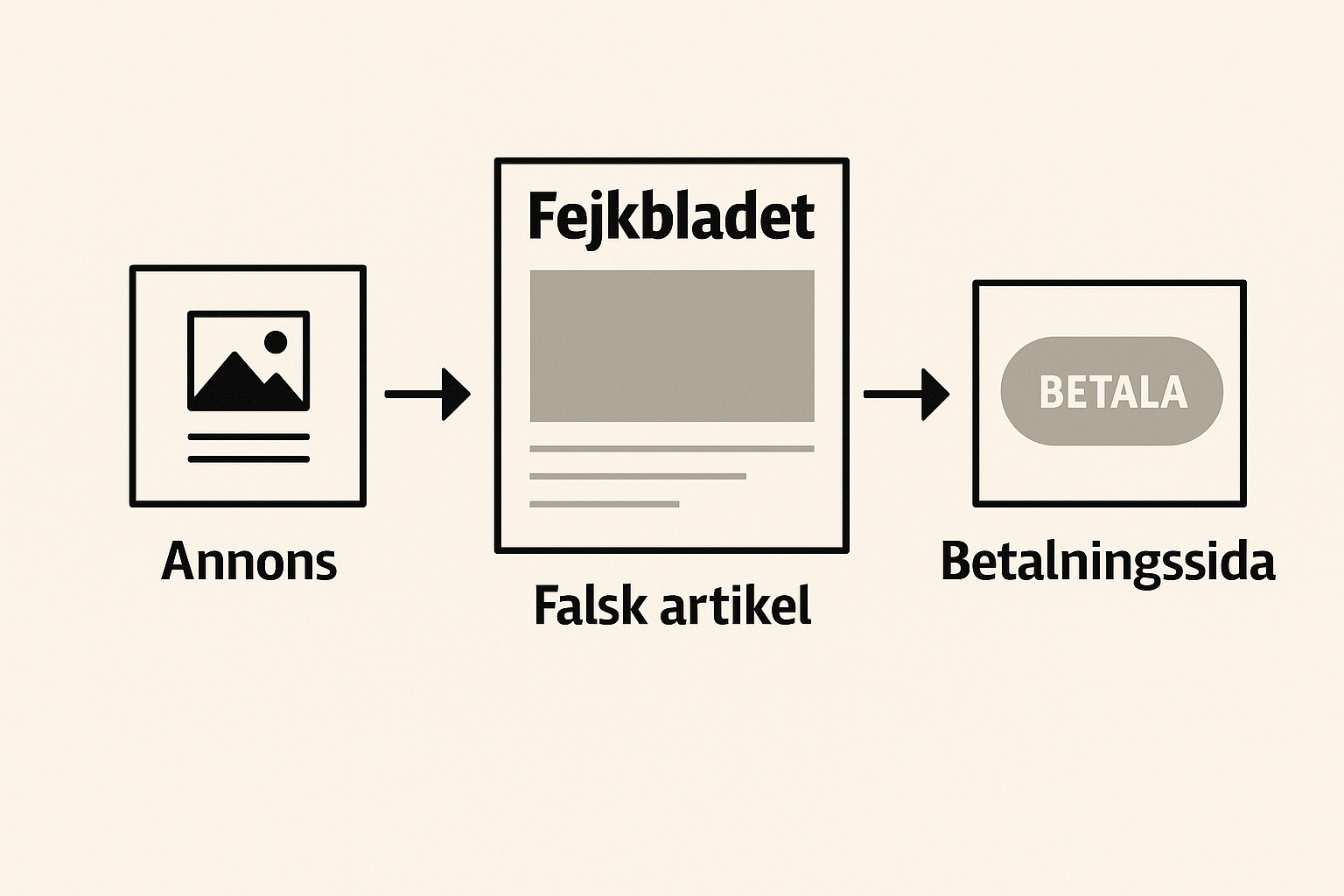
Illustrationen visar ett typiskt upplägg bedragare använder. Alla delar är fejkade och visas enbart som exempel för utbildning.

Steg 1: Rubriken som fångar dig

Bedragarnas rubriker är alltid känslostarka:

  • “Så tjänade [kändis] 50 000 kronor på en vecka”
  • “Ny investering chockar bankerna”
  • “EXKLUSIVT: [programledare] avslöjar hemligheten”

Varför det fungerar

De spelar på våra känslor. Här används ofta:

  • Auktoritet: kända namn eller medier lånar trovärdighet.
  • FOMO (Fear of Missing Out – rädslan att missa något): rubriken får dig att känna att du måste agera snabbt.
  • Urgency/Scarcity (brådska/knapphet): påståenden som “endast idag” eller “bara 20 platser kvar” stressar dig till beslut.

Steg 2: Den falska artikeln

fejkartikel från fejkbladet
Rubriken och bilden är helt fejkade. De används endast för att visa hur bedragare utnyttjar kända namn i falska nyheter.

När du klickar landar du på en sida som ser ut som en riktig nyhetssajt. Här används ofta WordPress-teman som imiterar tidningslayout: datum, författarnamn, kommentarer och bilder.

Vanliga trick

  • Lookalike-domäner: webbadresser som liknar riktiga (t.ex. aftonbladet-news.com istället för aftonbladet.se).
  • Falska bevis: skärmdumpar av “kontoutdrag” eller citat från kändisar.
  • Social proof (socialt bevis): påhittade kommentarer eller “antal delningar” för att ge känslan att många redan provat.

Steg 3: Knappen som leder till nästa steg

Mitt i texten finns alltid en tydlig knapp eller länk:
“Investera nu”, “Registrera dig här” eller “Läs mer”.

Vad som händer efter klicket

  • Du skickas via korta länkar (t.ex. bit.ly eller t.co) till nästa sida.
  • Redirects (vidarekopplingar) döljer vart du egentligen hamnar.
  • Ofta kommer du till en betalningssida där du ombeds göra en insättning eller betala en “verifieringsavgift”.

Steg 4: Avgifterna som aldrig tar slut

Ett klassiskt knep är att först begära en liten summa – ofta kallad “privacy fee” eller “confidentiality charge”. Det låter som en säkerhetsåtgärd, men är i själva verket första steget i en advance-fee-scam (förskottsbedrägeri).

När du väl betalat en gång ökar pressen: fler avgifter, fler “möjligheter”, större belopp. Till slut är förlusten enorm.

Exempel

  • En Växjöbo lurades av en falsk artikel om Agneta Sjödin och förlorade över 200 000 kronor.
  • Andra fall har handlat om falska annonser i Aftonbladets namn, där människor blivit av med sina besparingar.

💡 Tycker du att fler borde känna till hur dessa bluffar fungerar?
👉 Dela gärna artikeln i dina sociala medier och hjälp en vän att bli svårlurad.

Retoriska knep du kan avslöja

  1. Auktoritetssignaler – kändisnamn, logotyper, journalistisk ton.
  2. Social proof – påhittade kommentarer och “bevis”.
  3. Urgency/Scarcity – påtryckningar att agera snabbt, annars “missar du chansen”.
  4. Berättelsen om snabb rikedom – “den här personen tjänade stort, du kan också göra det”.

Så avslöjar du en bluff – checklista

fejkbladet logotyp
Rubriken och bilden är helt fejkade. De används endast för att visa hur bedragare utnyttjar kända namn i falska nyheter.
  • Kontrollera domänen noga: små stavfel avslöjar ofta bluffen.
  • Expandera kortlänkar innan du klickar (använd gratisverktyg online).
  • Sök på den riktiga nyhetssajten om artikeln verkligen finns där.
  • Kolla författarens profil – finns den på riktigt?
  • Gör en reverse image search på bilderna. Är de stulna?
  • Fråga dig själv: Varför skulle en seriös kändis tipsa om detta?

Om du blivit lurad – agera snabbt

  1. Kontakta din bank eller kortutgivare för att försöka stoppa betalningen.
  2. Spara skärmdumpar, mejl och kvitton som bevis.
  3. Anmäl till polisen och Konsumentverket.
  4. Rapportera annonsen till plattformen (Facebook, Instagram, YouTube).
  5. Sprid varningen vidare – utan att dela länken till bluffen.

Slutsats

Bedragarna använder samma knep som riktiga journalister och marknadsförare – men deras mål är att tömma ditt konto. Genom att förstå rubrikerna, retoriken och tricken kan du stå emot nästa gång en “för bra för att vara sann”-artikel dyker upp i ditt flöde.

FAQ (Vanliga frågor)

Vad är en falsk nyhetsartikel?

En falsk nyhetsartikel är en sida som utger sig för att vara journalistik, men som i själva verket är skapad för att lura människor till att klicka på länkar eller betala pengar.

Hur känner jag igen en bluffannons?

Var uppmärksam på kändisnamn i rubriker, konstiga domäner, brådska (“erbjudandet gäller idag”) och krav på små avgifter.

Vad gör jag om jag blivit lurad?

Kontakta banken omgående, spara alla bevis, och anmäl till polisen och Konsumentverket.

⚠️ Observera

Alla bilder, rubriker och exempel i denna artikel är fejkade och skapade enbart i utbildningssyfte. De visar hur bedragare manipulerar layout, rubriker och kända namn för att lura människor på nätet.

👉 Inga av exemplen representerar verkliga nyhetsartiklar, och artikeln innehåller inga externa länkar till bedrägerisidor.

10 Common SEO Myths (And What Experts Really Say)

When I started blogging, I had no idea what I was doing. In fact, I only began blogging because I wanted to practice my English, and I chose a topic close to my heart: dating and relationships.

Back then, I had no clue how to structure a blog, what search engine optimization (SEO) even was, or why it mattered. My first attempts were on Google’s old Blogger platform (yes, I’m old enough to remember that 😅). Eventually, I transitioned to WordPress — and that’s where I began to learn about SEO slowly.

It’s been a long journey. Thanks to experts like Neil Patel, Brian Dean (Backlinko), and Matt Diggity, I began to understand everything from alt descriptions to writing headings that keep visitors engaged, as well as how plugins can help me optimize content.

I also learned something crucial: SEO is slow, but powerful.
One of the best blog posts I’ve ever written took me about eight hours. It’s not even in the dating niche — but on my dating blog. To this day, it attracts over 100 visitors every week. Did that happen overnight? No. It took around six months for Google to rank it high enough.

That’s the power of SEO. However, along the way, I fell prey to many common myths. So let’s debunk them.

🚀 Quick Overview: SEO Myths vs. Reality

MythWhat beginners often believeWhat experts actually say
SEO is deadGoogle no longer cares about SEONeil Patel: SEO is alive and stronger than ever
Longer content always ranks betterWord count = rankingNeil Patel: Relevance beats length every time
SEO is a one-time projectDo it once and doneMatt Diggity: SEO is ongoing, not one-off
AI content gets punishedGoogle bans AI writingNeil Patel: Quality content ranks, regardless of who/what wrote it
Buying backlinks works instantlyMore links = betterMatt Diggity: Quality & relevance > volume
Duplicate content triggers penaltiesTwo similar pages = penaltyBrian Dean: No penalty, just filtering
Keyword density rulesMust be 2–3% exactBacklinko: Semantic relevance is what matters
SEO works overnightExpect results in 2 weeksMatt Diggity: Think 6–12 months, not days
Only big brands can rankSmall sites don’t stand a chanceBacklinko: Niche blogs can win on long-tail searches
Social signals drive rankingsMore shares = higher Google rankLonger content consistently ranks better

🕵️ Myth #1: “SEO is Dead”

Every year, someone claims SEO is dead. The truth? Google handles 8.5 billion searches daily. Organic search remains one of the most reliable and long-term traffic sources.
👉 Read Neil Patel’s blog article where he explains why SEO is far from dead. Here’s Brian Dean’s take on it as well.

📝 Myth #2: “Longer Content Always Wins”

When I first started, I believed this one. I wrote long posts just for the sake of length. Sometimes it helped, but only when the content was truly valuable.
👉 Matt Diggerty on content length vs. relevance

🔄 Myth #3: “SEO is a One-Time Project”

SEO isn’t a one-time checklist. Algorithms change, competitors update, and content gets stale. It’s a constant process of improvement.
👉 Matt Diggity explains why SEO is ongoing

🤖 Myth #4: “AI Content Gets Punished”

Many worry that AI writing = instant penalty. In reality, Google prioritizes usefulness over authorship. If your AI-assisted content helps users, it can rank just fine.

Matt Diggerty’s case study demonstrated how a human-AI combination would win the SEO game and increase revenue to $41,000.

🔗 Myth #5: “Buying Backlinks Guarantees Rankings”

Yes, links matter. But spamming cheap links is risky. High-quality, relevant backlinks remain one of the strongest ranking signals — but they require effort.

📄 Myth #6: “Duplicate Content Means Penalty”

Google doesn’t penalize duplicate content in the way people fear. It simply filters results to show the most relevant version.
👉 Brian Dean on duplicate content. Here’s Neil Patel’s take on duplicate content as well.

🔑 Myth #7: “Keyword Density Rules”

Forget obsessing over 2–3% keyword usage. Google is smarter. It understands context, synonyms, and topical authority.
👉 Whitehat-SEO.co.uk on keyword myths.

⏳ Myth #8: “SEO Results Come Fast”

I fell for this one, too. Truth is, SEO takes patience. My best post took six months to rank — but now it generates evergreen traffic.
👉 Matt Diggity on realistic SEO timelines

🏆 Myth #9: “Only Big Brands Can Rank”

It’s tempting to believe you can’t compete with giants. But niche blogs with focused, high-quality content often outperform big players on specific long-tail keywords.

📲 Myth #10: “Social Shares = Rankings”

Social signals don’t directly boost rankings. However, they can lead to secondary effects, such as increased traffic, backlinks, and engagement, which can ultimately benefit SEO.

🎯 What I’ve Learned (And What I’d Tell a Beginner Today)

When I started, I didn’t know what SEO was. I just wanted to practice writing. Along the way, I fell for these myths — and wasted time.

But once I learned from real experts, started using plugins, wrote with readers in mind, and focused on value, things changed.

My advice to you if you’re starting today:

  • Don’t chase myths. Focus on relevance and user value.
  • Play the long game. SEO is slow but compounding.
  • Learn from the best. Neil Patel, Brian Dean, Matt Diggity — follow their work.
  • Experiment. Your best traffic source might surprise you.
  • Be patient. Six months of effort can lead to years of passive traffic.

Oh yeah, and before I forget it. This article was written with a human-AI combo, so that you know. I’ve also shared the exact method I applied to my dating blog with one major exception. I’ve actually reached out to the experts who are mentioned in this one.

✅ Conclusion

SEO isn’t about tricks or hacks — it’s about building content that serves people better than your competition.

So don’t waste time chasing myths. Learn from experts, apply what works, and be patient. Your effort today might bring in traffic not next week, but six months from now — and then for years to come.

👉 Next Steps

5 AI Video Tools Compared: Why Viddeos AI Is the Best for Marketers in 2025

The AI video tool space is exploding — but which one actually saves you time and grows your business?

In this post, I compare the 5 best AI video creators and explain why Viddeos AI is now my go-to choice for daily video content.

The Contenders

  • Lumen5 – great templates, slower rendering
  • Pictory – solid editor, but limited voice control
  • InVideo – flashy UI, but capped usage limits
  • Synthesia – high-end avatars, expensive
  • Viddeos AI – real voiceovers, URL-to-video, unlimited renders

What Makes Viddeos Stand Out?

  • Instant script + voiceover from URLs or text
  • Unlimited usage with agency/commercial license
  • 52-week mentorship & templates
  • $20K+ in upgrades included

Who Should Use It?

If you’re an affiliate, coach, ecommerce seller, or content creator — Viddeos helps you get video content on the fly, without bottlenecks or hiring anyone.

Want to see it in action? Check out my full review + demo here.

How to Create AI Videos from URLs in 2 Minutes: A Step-by-Step Tutorial

Have you ever wanted to turn a blog post or product page into a high-converting video — instantly? In this tutorial, I’ll show you how I’m doing it in under 2 minutes using a tool called Viddeos AI.

Why Video from URLs Is the Future

Text content is great, but video is what grabs attention in 2025. Viddeos AI lets you paste in any URL — like your Shopify product, blog post, or landing page — and transforms it into a scroll-stopping video with:

  • Voiceover
  • Captions
  • Background visuals
  • Calls-to-action

No editing skills needed. No filming. No voice acting.

Step-by-Step: Create Your First Video from a URL

  1. Grab your source URL — blog post, sales page, etc.
  2. Paste into Viddeos — the AI extracts copy and key points.
  3. Choose a video style — explainer, story, or ad format.
  4. Select your voiceover & language (90+ options!)
  5. Customize colors, logo, or music if needed.
  6. Click render. Done in under 2 minutes.

My Real Example: Affiliate Blog → TikTok Video

I took my own blog post about Viddeos AI and turned it into a 59-second short that got over 3,000 views in a week. No hashtags, no promotion. Just a fast, clear video — built by AI.

Want to try it? Check out the full walkthrough and bonuses here.